



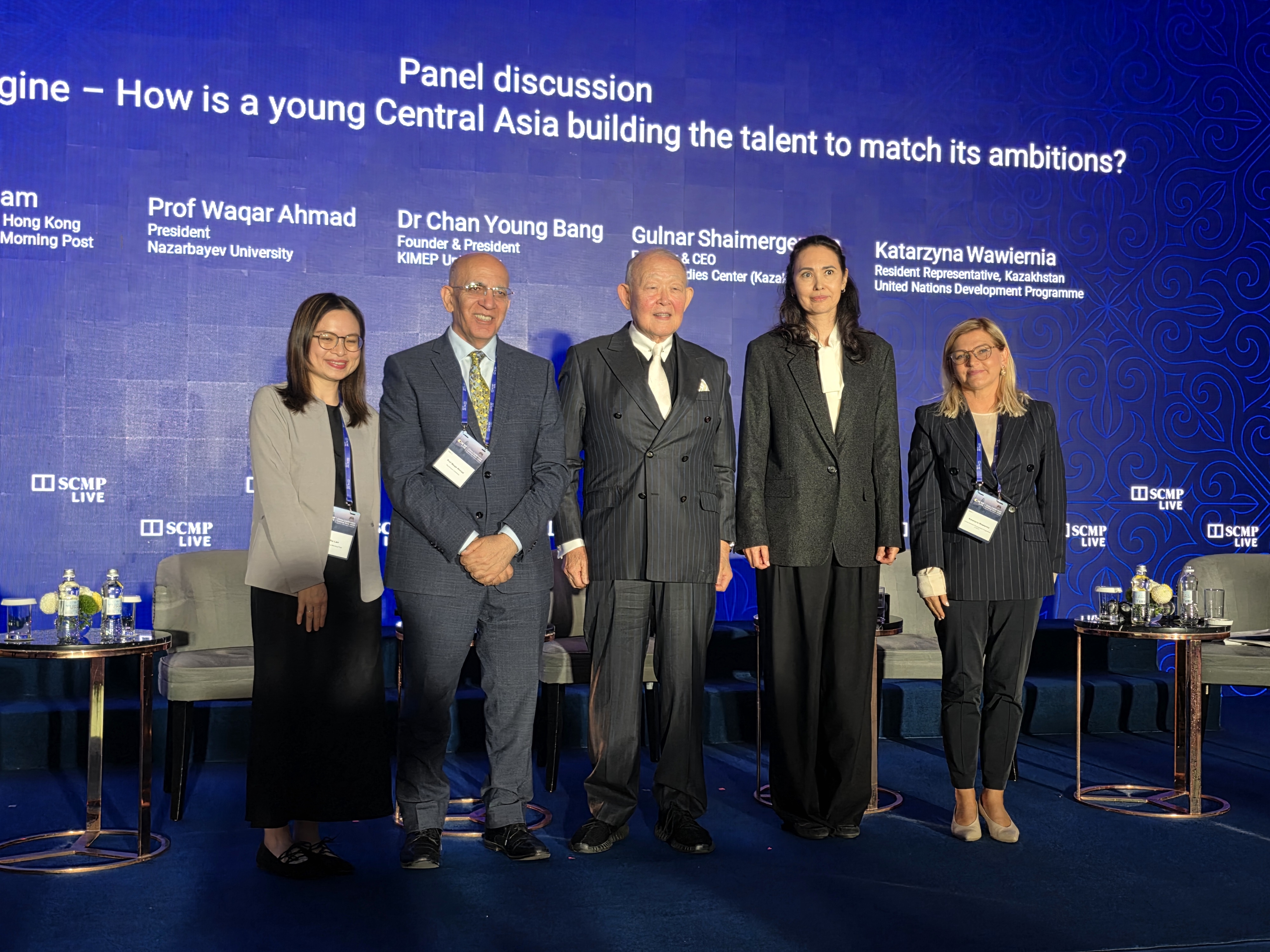
On September 7, Dr. Bang attended the China Conference: Central Asia in Astana, hosted
by the South China Morning Post and the Astana International Financial Centre. Dr.
Bang participated in a panel entitled: “The human engine – How is a young Central Asia
building the talent to match its ambitions?”
The Conference brought together Chinese and global investors, policymakers and
corporate leaders to examine how Chinese investment, trade and diplomacy will shape
the region’s growth over the next decade. The event aimed to surface emerging
opportunities and forge new cross-border partnerships.
During the panel, Dr. Bang was asked about how to properly structure a university,
strategies for local institutions to retain elite students and faculty, and incentives for local
top-tier talent to either stay or return to Kazakhstan.
Dr. Bang argued that working through the legacy of Soviet universities is essential for
any elite university in Kazakhstan, in order to meet the global market needs of today. He
offered KIMEP as an institution that other universities can model, in order to increase the
quality of education among Kazakhstani universities. He emphasized the importance of
the student-centered culture at KIMEP, as well as the need for external, non-biased
review, and constantly being willing to adjust to feedback to make academic programs
better. Dr. Bang also contended that Kazakhstani students going abroad was not inherently a bad
thing for Kazakhstan. He said that Kazakhstan could look to China, who has many
students that study abroad, but whose students also return. China has achieved an
immense amount of economic growth in the last decade, which he hopes Kazakhstan will
follow.
Dr. Bang asserted that this is one of the ways for Kazakhstan to get its students to stay at
home, in providing meaningful, competitive economic opportunities for them. He said
that companies need to be able to provide top-tier salaries to these students, and be able
to offer them career opportunities equal to what they could get abroad.
In order to achieve such economic growth to make this a reality, Dr. Bang said that
Kazakhstan needed bold educational reform. Some educational institutions in Kazakhstan
still have a Soviet structure, which he maintains does not adequately prepare graduates to
enter the market economy. Instead, these universities need administrators who can lead
with the new principals of management and are willing to center student voices.
However, with this, Dr. Bang believes that Kazakhstan can double its GDP in the next
decade, and provide local students with incentives to stay in the country.
The conference also marked a continuation of Dr. Bang’s relationship with the South
China Morning Post, in which he has published 18 articles regarding emerging political
and economic issues – well in line with the conference’s themes.
Dr. Bang also had the opportunity to reconnect with some KIMEP graduates, who are
now working in Astana. They thanked Dr. Bang, and said that their KIMEP education
was instrumental in their success.